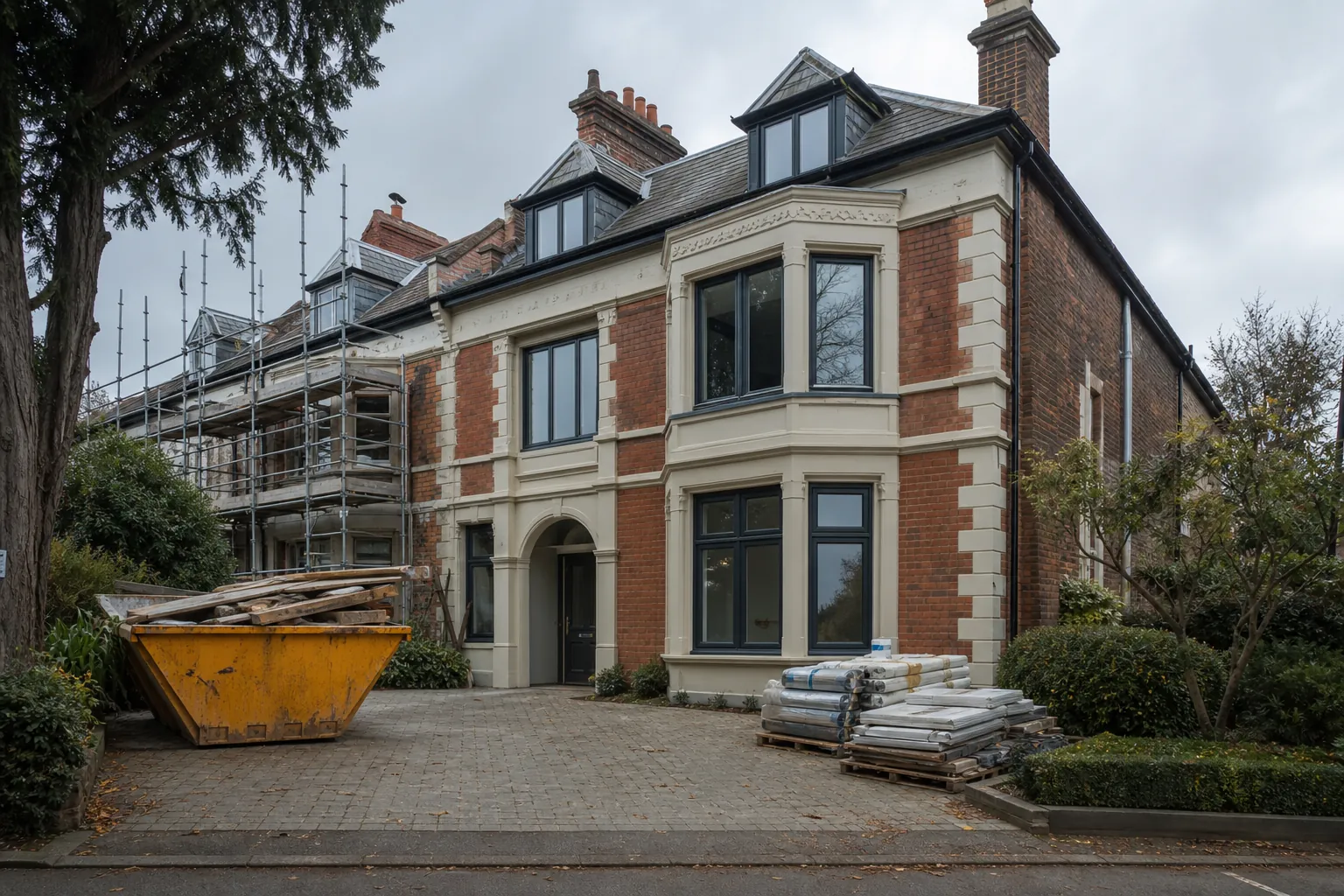
Supported living HMO conversion finance
Funding for buying and converting houses and HMOs to supported living standard, structured around the works programme and the lease-up to a provider rather than around a finished income.

Funding hmo conversion
A supported living HMO conversion is the process of taking ordinary residential stock, often an existing house in multiple occupation, adapting it to the standard a provider requires, and then letting it on to that provider. It is the route most active investors take into the sector, because buying stock already let means paying someone else's profit, while converting means capturing the uplift yourself.
The finance follows the same shape as any refurbishment-to-let deal, with one important difference: the exit depends on a third party signing a lease. A refurbished buy-to-let can be let to almost anybody at a market rent. A converted supported living property has value at the enhanced rent only if a provider takes it. That single dependency is what shapes how these deals are funded and where they go wrong.
What we fund
- Existing HMOs converted to supported living standard
- Family houses adapted for a provider to take on lease
- Larger properties reconfigured into self-contained supported units
- Accessibility adaptations including level access, wet rooms and hoists
- Fire safety and compliance works to the standard a provider requires
- Purchase, works and lease-up funded as a single structured facility
Indicative terms
- Typical project size (indicative)£150k to £2m
- Bridging LTV (indicative)Up to around 70 to 75% of purchase, plus works
- Bridging rates (indicative)From around 0.75% per month
- Exit routeTerm debt once the lease is signed, or a sale to an investor
Indicative only. Terms vary by lender, asset and borrower and are not an offer of finance.
Funding purchase, works and the lease-up in one structure
We arrange bridging or refurbishment finance for the purchase and the conversion works, typically at up to around 70 to 75 percent of the purchase price with the works funded in staged drawdowns against a schedule, at indicative rates from around 0.75 percent a month. The facility needs a term long enough to cover not just the build programme but the lease-up period afterwards, which investors routinely underestimate. Once a provider is on a signed lease and rent is flowing, we refinance onto a commercial mortgage or term loan. Where the plan is to sell the completed unit to an investor rather than hold it, the bridge is structured around a sale exit instead. We arrange and introduce; we do not lend.
The lease-up gap, and why bridging lenders focus on it
A bridging lender's main question on these deals is not whether the works can be done, it is what happens between practical completion and a signed lease. If the works finish in month four and a provider does not sign until month eleven, the facility has to survive seven months with no income, and the borrower has to service it. Lenders therefore want to see evidence of provider interest before drawdown, ideally heads of terms or a letter of intent, not an assumption that a provider will appear. They will also test the exit: whether a term lender will refinance at the assumed value, and what the property is worth as an ordinary house if no provider ever takes it. Deals presented with a named provider and a realistic timeline get funded on materially better terms than deals presented on hope.
Refinancing a converted unit onto term debt
The exit is where the profit is realised and where the arithmetic needs to be honest. On refinance the term lender values the completed, let property, and as covered elsewhere on this site, it may value on vacant possession rather than on the capitalised lease rent. An investor who has spent £220,000 buying and converting a house, and expects it to be worth £300,000 on the strength of the lease, may find the term lender values it at £200,000 as an ordinary house and lends 65 percent of that. That leaves more capital tied up than the plan assumed. We establish the likely term valuation basis before the bridge is drawn, so the exit is modelled on the number the lender will actually use rather than on the one the appraisal wanted.
Finance that suits this asset class
- Bridging financePurchase and staged works funding through to lease-up.
- RefinanceMoving onto term debt once a provider is on the lease.
- Development financeHeavier reconfigurations and multi-unit schemes.
Useful calculators
Related guides
Fund a hmo conversion deal
A view on fundability within one working day.
Is supported living classed as an HMO?
Sometimes, and it depends on the configuration rather than on the label. Where residents occupy self-contained flats with their own facilities, the property is generally not an HMO. Where several unrelated residents share a kitchen or bathroom, it is likely to meet the HMO definition and may require an HMO licence from the local authority, even though it is being used as supported accommodation.
This matters to a lender in two ways. An HMO licence requirement adds a compliance step and a cost, and it changes which lenders will consider the property, since some restrict HMO lending by size or location. It also affects the vacant possession valuation, because an HMO and a family house in the same street are worth different amounts. We establish the licensing position early rather than at valuation.
Planning and use class on a conversion
Use class depends on how the accommodation is configured and how much care is provided. Self-contained supported flats and houses generally sit in residential use, while grouped accommodation where personal care is provided can fall into use class C2, residential institutions. Converting from ordinary residential use may therefore require planning permission for a change of use, and that timeline has to be built into any short-term facility.
One point often misreported: the government confirmed in its 2026 consultation response on supported housing regulation that it will not change the planning use class treatment of supported housing at this stage, and will review the position after three years when it evaluates the licensing regime. Anyone telling you a use class reform is imminent is ahead of the evidence. What is coming is licensing, not a planning change.
What providers actually require before they will sign
Providers are not short of offers of property, so they are selective. Typically they want the property in the right location for the people they support and the commissioning authority they work with, configured correctly for the cohort, compliant on fire safety and accessibility, and available on lease terms they can sustain. Location relative to a specific local authority's demand is often the deciding factor, and it is the one an investor cannot fix after purchase.
The practical advice is to talk to providers before buying rather than after converting. An investor who buys, converts and then goes looking for a provider has taken the biggest risk in the deal in the wrong order, and they carry the cost of every month the property sits empty.
How long residents stay, and why funders ask
Supported living is generally a long-term or permanent home rather than temporary accommodation, so residents can stay for many years, often for as long as their support needs continue. That stability is what gives a provider the confidence to commit to a long lease, and it is why a converted supported living property can support 20 or 25 year lease terms that ordinary residential letting never would.
For a lender, settled long-term occupation supports the durability of the rent the provider pays. It is one reason supported living income reads differently from mainstream residential letting: the demand is structural and the tenure is long, so the lease the loan is sized against is more likely to run its course.
Worked example: converting a house to supported living
An investor buys a four-bedroom house for £180,000 with the intention of adapting it to supported living standard at a cost of £45,000, then letting it on a 20-year CPI-linked FRI lease to a provider at £17,500 a year. These figures are illustrative only and not an offer of finance.
A bridging lender advances 70 percent of the purchase price, £126,000, plus the £45,000 of works released in staged drawdowns against a surveyor's schedule, giving a facility of £171,000 against a total project cost of £225,000. The investor puts in £54,000 plus fees and interest. At an indicative 0.85 percent a month, interest runs at roughly £1,450 a month once fully drawn, which the investor services from other resources because the property produces nothing until the lease starts.
The works take five months. The provider signs three months after that. Over those eight months the investor has carried around £11,000 of interest, a cost that is easy to leave out of an appraisal and hard to avoid in practice. Structuring the bridge for twelve months rather than nine avoids the far more expensive problem of needing an extension.
On refinance the term lender values the completed property. If it uses the investment basis it may support £250,000 and lend £162,000 at 65 percent, close to clearing the bridge. If it uses vacant possession and values the adapted house at £195,000, the term loan is roughly £127,000 and the investor must find the difference. Knowing which basis applies before drawing the bridge is the whole game on a conversion.
Illustrative worked example only. Figures vary by lender, asset and borrower and are not an offer of finance.
Frequently asked questions
Is supported living classed as an HMO?
It depends on configuration. Self-contained supported flats generally are not HMOs. Where several unrelated residents share a kitchen or bathroom the property is likely to meet the HMO definition and may need an HMO licence from the council. That affects which lenders will consider it and what it is worth on a vacant possession basis.
What is the difference between assisted living and supported living?
Supported living usually means working-age adults with learning disabilities, mental health needs or physical disabilities living in their own homes with support bought separately. Assisted living usually means age-restricted housing for older people with care available on site. They are funded differently and underwritten differently, so the terms are not interchangeable in a finance context.
How long can you stay in supported living?
It is generally a long-term or permanent home rather than temporary accommodation, so residents often stay for many years, for as long as their support needs continue. That settled occupation is what allows providers to commit to 20 and 25 year leases, which is what makes the investment case work.
Do I need planning permission to convert a house to supported living?
Possibly. Self-contained supported homes generally sit in residential use, while grouped accommodation with personal care can fall into use class C2, which would require a change of use. The government confirmed in 2026 that it is not changing the planning use class treatment of supported housing at this stage and will review it after three years.
How long should I take a bridging facility for on a conversion?
Longer than the build programme. The period that catches investors out is between practical completion and a provider signing the lease, which can run to several months. Structuring for twelve months rather than nine is usually cheaper than needing an extension, and lenders take a better view of a deal with a realistic timeline and evidence of provider interest.
Funding a hmo conversion asset?
Tell us about the deal and we will come back with a view on fundability and likely terms.