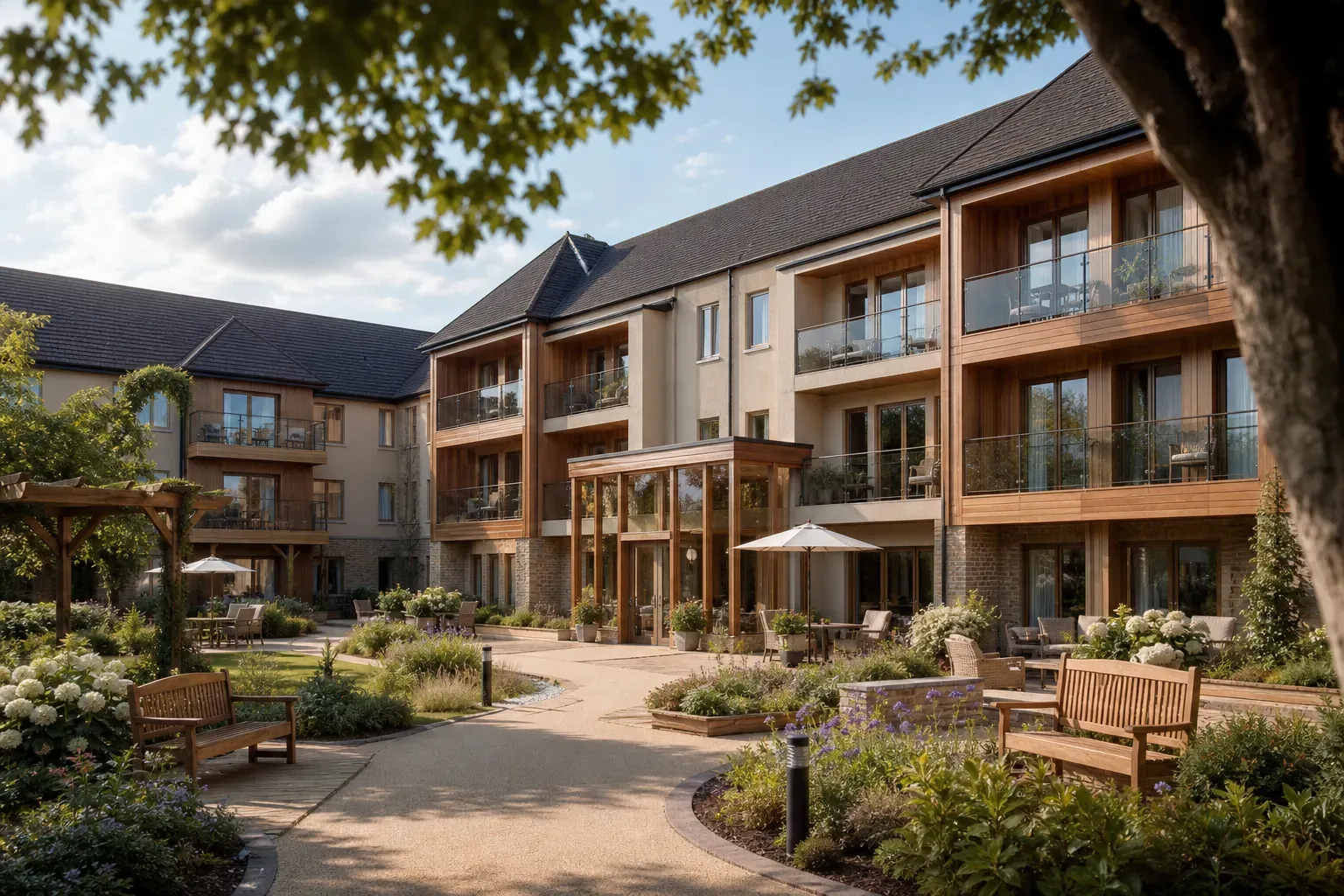
Extra care housing investment finance
Funding for extra care schemes, where older residents live independently in their own apartments with care available on site, arranged around the tenure mix and the delivery route.

Funding extra care
Extra care housing is self-contained accommodation for older people where residents hold their own tenancy or own their apartment, with communal facilities and care available on site as needs change. It sits between mainstream retirement housing and residential care: residents keep their own front door, while staff, communal space and a service charge make staying put possible as needs grow.
For a funder, extra care is a development and tenure problem rather than a lease problem. Income can come from outright sales, shared ownership, affordable or social rent, a lease to an operator, or a mixture, and the mix determines which lenders will look at it and how the debt is structured. We arrange development finance, forward funding and term debt on extra care, and we work out which of those routes a scheme actually fits before approaching the market.
What we fund
- Purpose-built extra care schemes with communal facilities and on-site care
- Affordable and social-rented extra care delivered with a registered provider
- Mixed-tenure schemes combining outright sale, shared ownership and rent
- Schemes forward funded for a housing association or operator
- Conversions of redundant buildings to extra care standard
- Extra care schemes let on a long lease to a specialist operator
Indicative terms
- Typical scheme size (indicative)£3m to £40m and above
- Development funding (indicative)Up to around 60 to 70% of cost
- Term LTV (indicative)Up to around 60 to 70% of value
- Seniors housing comparatorPrime South East 5.50% NIY (Knight Frank, Feb 2026)
Indicative only. Terms vary by lender, asset and borrower and are not an offer of finance.
Funding an extra care scheme through delivery
We arrange development finance for ground-up and conversion extra care schemes, indicatively up to around 60 to 70 percent of cost, with interest rolled up and drawn in stages against a monitoring surveyor's certificates. The exit is either a sale of the apartments, a refinance onto term debt against the retained income, or a forward sale to a housing association or institutional buyer agreed before a spade goes in the ground. Where a scheme is forward funded, the funder effectively buys the completed scheme and finances delivery, which usually produces the cheapest capital but requires the buyer to be committed early. Where equity is short we introduce mezzanine finance or joint venture partners. We act as arranger and introducer, not as a lender.
What funders assess on a later-living scheme
Lenders assess extra care schemes on viability rather than on covenant, because there is usually no single lease to underwrite. They look at the build cost and the contractor, the tenure mix and how realistic the assumed sales or rents are, the service charge and whether residents can sustain it, and the operator or management arrangement that will run the scheme once occupied. Sales rate is the variable that kills schemes: later-living apartments often sell more slowly than mainstream housing because buyers must first sell their existing home, and a funder will stress that rate hard. Where a scheme is pre-sold or forward funded to a registered provider, most of that risk falls away and the terms improve sharply, which is why we test that route first on any scheme that could support it.
Pricing, demand and the institutional bid
The demographic case is unusually clear. The UK population aged 85 and over is projected to reach around 3.0 million by mid-2043, close to double the 1.6 million recorded in mid-2018 (Office for National Statistics, national population projections), and 71% of the supported housing owned by social landlords in England is already let to older people (National Housing Federation, Supported housing in England: Estimating need and costs to 2040). Institutional appetite reflects that: prime South East seniors housing moved to 5.50% on a net initial yield basis in February 2026, out from 5.25 percent in December 2025 (Knight Frank Intelligence Prime Yield Guide, prepared 24 February 2026). For a developer the practical consequence is that a completed, occupied extra care scheme has a real institutional buyer pool, which makes the exit more certain than on many development types, provided the scheme has been built to a specification that pool will accept.
Finance that suits this asset class
- Development financeGround-up and conversion delivery, drawn in stages.
- Mezzanine financeTopping up senior debt where equity is short.
- Commercial mortgagesTerm debt on the retained, income-producing scheme.
Useful calculators
Related guides
Fund a extra care deal
A view on fundability within one working day.
What is meant by extra care housing?
Extra care housing is self-contained accommodation for older people, with communal facilities and personal care available on site, where residents hold their own tenancy or own their home. Schemes typically include a restaurant or cafe, communal lounges, a laundry, and staff on site around the clock, with care delivered to each resident according to an assessed need rather than as a blanket service.
The distinction from a care home is legal as well as practical. In extra care the resident has their own home and buys care separately; in a care home the resident is accommodated by an operator who provides both. That difference is why extra care is financed as property and a care home is financed as a business.
Who qualifies for extra care housing?
Eligibility is set locally rather than nationally. Schemes are generally restricted by age, commonly 55 or 60 and over, and for the affordable and rented apartments a local authority will usually assess care and support needs and housing need before allocating. Outright sale and shared ownership apartments in the same scheme are typically available to anyone meeting the age restriction.
This matters to a funder because it determines the depth of the market for each part of a scheme. The rented element depends on a local authority's allocation and commissioning, while the for-sale element depends on the local older owner-occupier market and their ability to sell their existing homes. A scheme that assumes strong demand for both needs to evidence both.
How much does extra care housing cost residents?
Residents typically pay rent or a purchase price for the apartment, a service charge covering the communal facilities and on-site staffing, and then the cost of their personal care, which may be funded by the local authority, by the NHS, or privately depending on the resident's assessed needs and means. The service charge is the element that varies most between schemes and the one that most affects long-term viability.
For an investor or developer the service charge is a viability question rather than a detail. Set it too low and the scheme cannot fund the staffing that makes it extra care; set it too high and residents cannot sustain it and the scheme struggles to fill. Funders look at this closely because a scheme that cannot fill cannot service debt.
How extra care differs from supported living
Extra care is for older people and is built around ageing in place, with a service charge funding communal facilities and on-site staff. Supported living is generally for working-age adults with learning disabilities, mental health needs or physical disabilities, is usually delivered in ordinary houses and flats rather than in a scheme, and is funded through housing benefit under exempt accommodation rules.
For finance the difference is fundamental. Supported living is a lease and covenant proposition, underwritten on the provider. Extra care is a development and viability proposition, underwritten on build cost, tenure mix and sales or letting rate. They are different asset classes that happen to share some vocabulary, and confusing them sends a deal to entirely the wrong lenders.
Worked example: forward funding an extra care scheme
A developer has a site with consent for a 48-apartment extra care scheme. Build and associated costs total £11m including land at £1.6m, and a housing association has agreed to forward fund the scheme, taking the completed building for £13.2m. These figures are illustrative only and not an offer of finance.
Because the exit is contracted before a spade goes in the ground, the risk profile changes completely. Rather than funding to a speculative sales exit, a lender is funding delivery against a contracted purchaser with a known covenant. Development finance at around 70 percent of cost, roughly £7.7m, is drawn in stages against monitoring surveyor certificates with interest rolled up, and the developer contributes the remaining £3.3m in land value and equity.
The lender's diligence centres on the build contract and the contractor, the forward funding agreement itself and what happens if the association walks away, and the association's own covenant and regulatory standing. Where the forward funding agreement is robust, pricing sits well below what a speculative later-living scheme would attract, because sales rate risk, the variable that most often derails later-living development, has been removed.
On practical completion the association pays £13.2m, the facility is repaid and the developer takes a margin of around £2.2m on cost before finance costs. The same scheme built speculatively would have needed a slower drawdown, more equity, a longer facility to allow for the sales programme, and a materially higher rate.
Illustrative worked example only. Figures vary by lender, asset and borrower and are not an offer of finance.
Frequently asked questions
What is meant by extra care housing?
Extra care housing is self-contained accommodation for older people with communal facilities and personal care available on site, where residents hold their own tenancy or own their apartment. Care is delivered to each resident according to assessed need rather than as a blanket service, which is what distinguishes it legally and financially from a care home.
Who qualifies for extra care housing?
Eligibility is set locally. Schemes are generally age-restricted, commonly to 55 or 60 and over, and for rented and affordable apartments a local authority will usually assess care, support and housing need before allocating. Outright sale and shared ownership apartments are typically open to anyone meeting the age restriction.
What is the difference between extra care and supported living?
Extra care is for older people, built around ageing in place, with a service charge funding communal facilities and on-site staff. Supported living is generally for working-age adults with learning disabilities, mental health or physical disabilities, delivered in ordinary houses and flats and funded through housing benefit. In finance terms one is a viability proposition and the other a lease and covenant proposition.
How is extra care housing development funded?
Usually development finance at indicatively up to around 60 to 70 percent of cost, drawn in stages against a monitoring surveyor's certificates with interest rolled up. The exit is a sale of the apartments, a refinance onto term debt, or a forward sale to a housing association or institution agreed before construction starts, which is the cheapest route where it is available.
What is the yield on extra care and seniors housing?
Prime South East seniors housing stood at 5.50 percent on a net initial yield basis in February 2026, out from 5.25 percent in December 2025, on the Knight Frank Intelligence Prime Yield Guide. That is the nearest published institutional benchmark. Individual schemes vary widely with tenure mix, location and the operator arrangement.
Funding a extra care asset?
Tell us about the deal and we will come back with a view on fundability and likely terms.