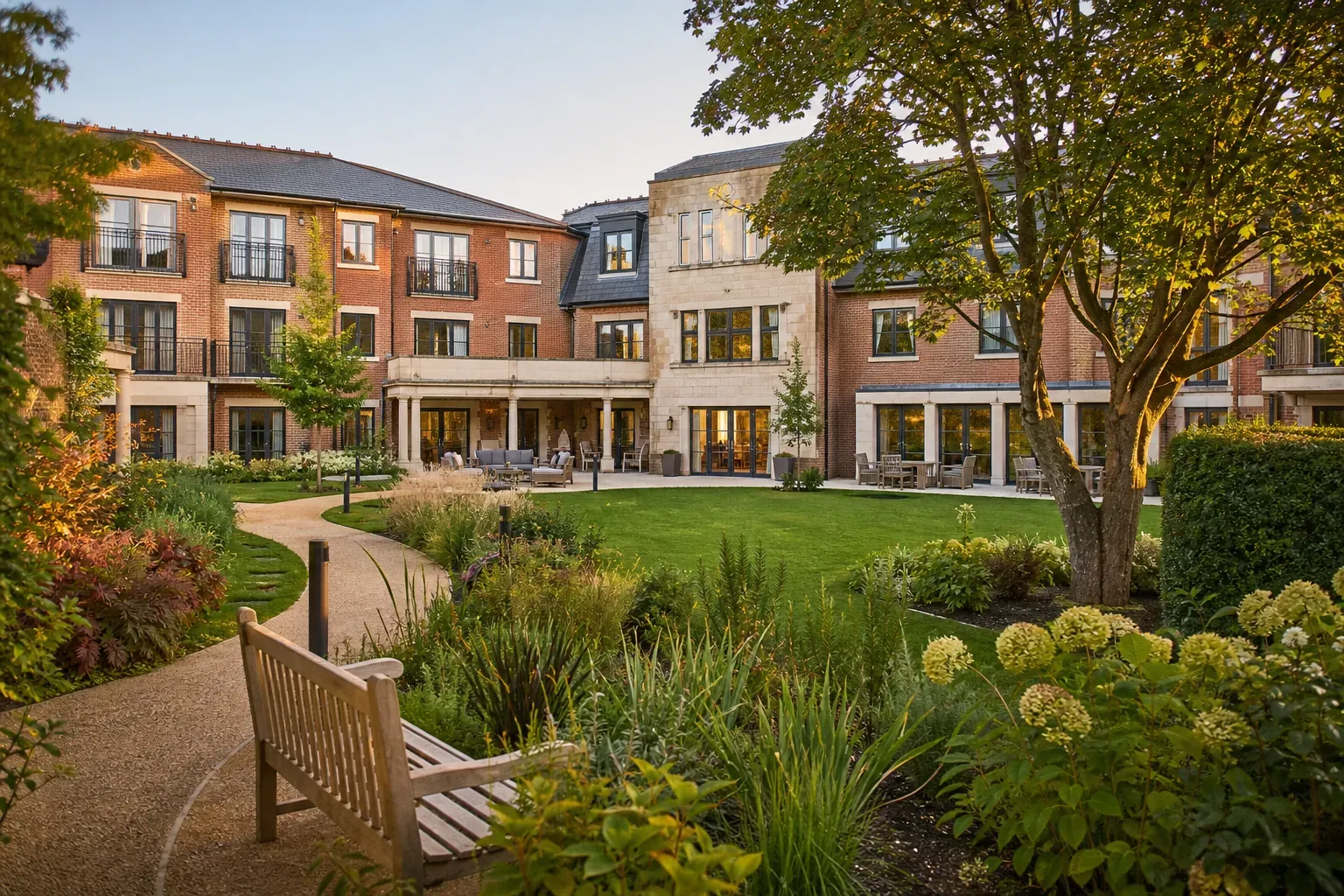
Retirement living investment finance
Funding for retirement living and later living schemes, age-restricted housing without the care intensity of extra care, financed around the sales programme and the ground rent or service-charge model.

Funding retirement living
Retirement living is age-restricted housing designed for older people who are largely independent, typically with a house manager, communal lounge and safety features, but without the on-site care team that defines extra care. It is the largest and longest-established part of the UK later-living market and is delivered mostly for outright sale, with a service charge funding the communal offer.
For a funder this is a residential development proposition with an unusual sales profile. Buyers are older, almost always chain-dependent because they must sell an existing home, and sensitive to service charge levels and to the terms on which they eventually sell. Those characteristics make the sales rate the central financing question, and any facility on a retirement living scheme has to be built to survive a slower absorption than a mainstream housing scheme would assume.
What we fund
- Purpose-built retirement apartment schemes for outright sale
- Age-restricted bungalow and cottage developments
- Retirement living schemes with shared ownership elements
- Conversions of period and redundant buildings to retirement apartments
- Rental retirement living held as a long-term investment
- Later living schemes forward sold to an institutional owner
Indicative terms
- Typical scheme size (indicative)£2m to £30m and above
- Development funding (indicative)Up to around 60 to 70% of cost
- Term LTV (indicative)Up to around 60 to 65% on a retained rented scheme
- Demographic driverOver-85s to around 3.0 million by 2043 (ONS)
Indicative only. Terms vary by lender, asset and borrower and are not an offer of finance.
Funding a later living scheme against the sales programme
We arrange development finance for retirement living schemes, indicatively up to around 60 to 70 percent of cost, drawn in stages with interest rolled up and repaid from unit sales as they complete. The facility term is the critical negotiation on these deals: a retirement scheme that would sell out in twelve months as mainstream housing may take twenty-four or more, and a facility sized to the optimistic case creates a refinancing problem exactly when sales are slowest. Where a scheme is retained and rented rather than sold, we arrange term debt against the rental income and service-charge structure. Where the equity requirement is heavy we introduce mezzanine finance or joint venture capital. We arrange and introduce; we do not lend.
How development funders stress a retirement scheme
Funders test three things hardest on later living. First, the sales rate, because older buyers are chain-dependent and absorption is slower than mainstream residential; a lender will model a materially slower rate than the appraisal assumes and check the facility still works. Second, the service charge and any deferred or event fee arrangement, because these affect both saleability and the scheme's reputation with buyers, and consumer scrutiny of later-living charging structures has been sustained. Third, the specification against what an institutional buyer would accept if the scheme is later sold as a block rather than unit by unit, which is the fallback exit. A scheme that only works if every apartment sells individually at full price within eighteen months is a scheme most funders will decline or price heavily.
Demand, and the gap between demographics and delivery
The demographic driver is not in doubt. The UK population aged 85 and over is projected to rise from 1.6 million in mid-2018 to around 3.0 million by mid-2043 (Office for National Statistics, national population projections), and the National Housing Federation estimates England needs at least 167,000 more supported homes by 2040, with older people accounting for the large majority of existing supported stock. Delivery has not kept pace, and the development cost of closing that gap is put at £33.9bn to 2040 (National Housing Federation, Supported housing in England: Estimating need and costs to 2040). For a developer that undersupply is the opportunity, but it is a long-run structural argument rather than a guarantee that a specific scheme in a specific town will sell quickly. Funders make that distinction, and appraisals should too.
Finance that suits this asset class
- Development financeStaged funding through construction and the sales programme.
- Mezzanine financeReducing the equity requirement behind senior debt.
- Equity and JVPartnering where a scheme needs more than debt.
Useful calculators
Fund a retirement living deal
A view on fundability within one working day.
What retirement living means in the UK market
Retirement living is age-restricted housing for older people who live independently, usually apartments with a house manager, a communal lounge, secure entry and emergency call systems, sold with a lease and a service charge. There is no on-site care team, which is the line between retirement living and extra care, and residents who later need care arrange it privately or through the local authority as anyone living at home would.
The sector is dominated by a handful of national developers alongside regional operators and housing associations, and most delivery is for outright sale. That commercial structure is why the financing question is a sales question rather than a covenant question.
Why later living absorption runs slower
A buyer of a retirement apartment is almost always selling a family home to fund the purchase, which means every sale depends on a second transaction completing elsewhere. Add the emotional weight of the decision, frequent involvement of adult children, and the buyer's scrutiny of the service charge, and the result is a longer decision cycle than in mainstream residential.
The practical consequence for finance is that the facility term must accommodate the real absorption rate. We have seen otherwise sound schemes get into difficulty purely because the debt was sized to a twelve-month sell-out that was never realistic. Building in a longer term at the outset costs a little more in commitment fees and saves a great deal in extension fees and forced discounting.
Service charges, event fees and lender caution
Retirement leases commonly carry a service charge covering the house manager, communal areas and building costs, and some carry event fees payable on sale or sublet. These arrangements have attracted sustained consumer and regulatory attention, and they affect resale values as well as initial sales.
Lenders take an interest because a charging structure that damages resale prices damages their security. A scheme with transparent, proportionate charges is easier to fund than one relying on aggressive deferred fees, and a developer who can evidence resale performance on comparable schemes is in a materially stronger position when arranging debt.
Renting rather than selling: the build to rent later living route
A growing share of later living is delivered for rent rather than for sale, which changes the finance profile from a sales-led development facility to a development loan with a term debt exit against stabilised rental income. That removes sales rate risk and replaces it with lease-up risk, which most funders regard as the easier of the two.
It also opens an institutional exit. Prime South East seniors housing was priced at 5.50% on a net initial yield basis in February 2026 (Knight Frank Intelligence Prime Yield Guide, prepared 24 February 2026), and a stabilised rented later-living scheme built to institutional specification has a real buyer pool. Where a site can support either route, we model both before recommending which to take to market.
Worked example: a retirement apartment scheme for sale
A developer builds 24 retirement apartments in a market town. Land and build costs total £6.4m and gross development value is £8.8m at an average of around £367,000 per apartment. These figures are illustrative only and not an offer of finance.
A development lender advances 65 percent of cost, roughly £4.16m, drawn in stages against monitoring surveyor certificates with interest rolled up, leaving the developer to fund £2.24m in land and equity. On paper that is a £2.4m margin on cost, a healthy scheme.
The variable that decides whether it is is the sales rate. At four sales a month the scheme clears in six months after practical completion and the arithmetic holds. At one and a half sales a month it takes sixteen months, and the rolled-up interest on a facility that size runs to several hundred thousand pounds more than the appraisal assumed, eroding the margin materially. A lender will model the slower case and size the facility to survive it.
The prudent structure takes a facility term covering construction plus at least eighteen months of sales, accepts the slightly higher commitment cost, and agrees a partial repayment schedule that releases apartments as they sell. The alternative, a tight facility that needs extending mid-sales programme, puts the developer in exactly the position where discounting starts.
Illustrative worked example only. Figures vary by lender, asset and borrower and are not an offer of finance.
Frequently asked questions
What is retirement living in the UK?
Retirement living is age-restricted housing for older people who live independently, usually apartments with a house manager, communal lounge, secure entry and emergency call systems, sold with a lease and a service charge. There is no on-site care team, which is the line between retirement living and extra care housing.
How is a retirement living scheme financed?
Usually development finance at indicatively up to around 60 to 70 percent of cost, drawn in stages with interest rolled up and repaid from unit sales. The facility term is the key negotiation, because later-living absorption runs slower than mainstream residential and a facility sized to an optimistic sell-out creates a refinancing problem when sales are slowest.
Why do retirement apartments sell more slowly?
Buyers are almost always selling a family home to fund the purchase, so every sale depends on a second transaction. Add a longer decision cycle, frequent family involvement and scrutiny of the service charge, and absorption runs well below mainstream residential. Funders model a slower rate than most appraisals assume.
Is retirement living a good investment?
The demographic case is strong: the UK population aged 85 and over is projected to reach around 3.0 million by mid-2043 from 1.6 million in mid-2018 on ONS projections. That is a long-run structural argument, not a guarantee that a particular scheme in a particular town will sell quickly, and the difference between those two things is where later-living schemes get into trouble.
Can retirement living be built for rent instead of sale?
Yes, and a growing share is. That replaces sales rate risk with lease-up risk, which most funders regard as easier, and opens an institutional exit. Prime South East seniors housing was priced at 5.50 percent net initial yield in February 2026 on the Knight Frank Prime Yield Guide, so stabilised rented later-living schemes built to institutional specification have a real buyer pool.
Funding a retirement living asset?
Tell us about the deal and we will come back with a view on fundability and likely terms.